

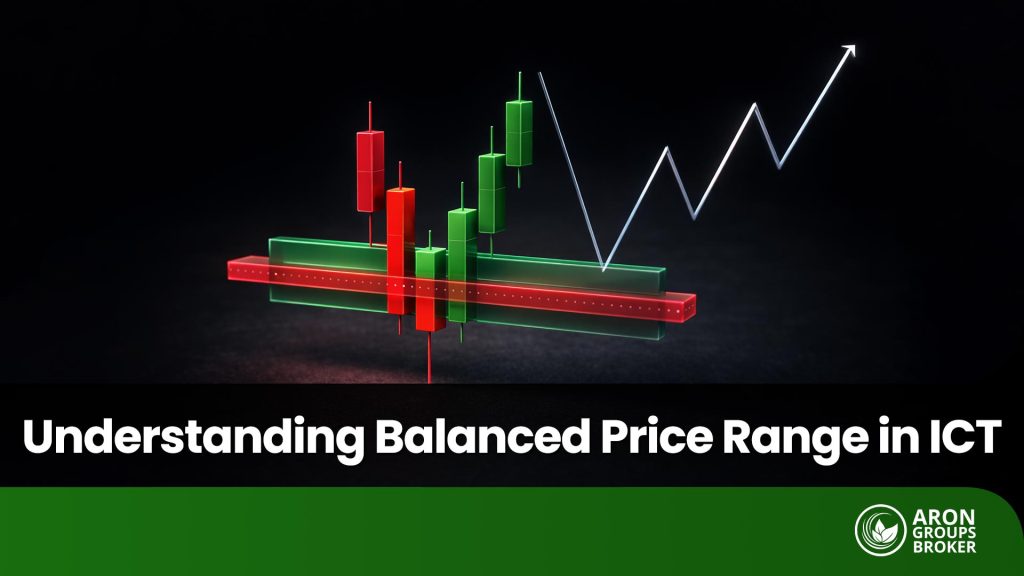
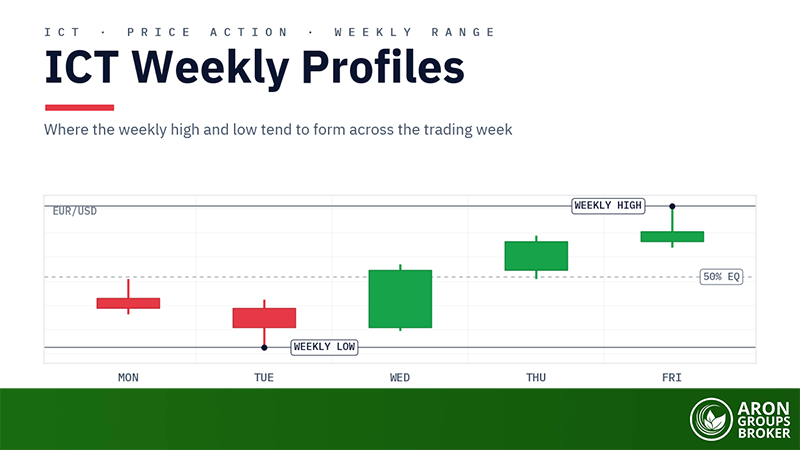

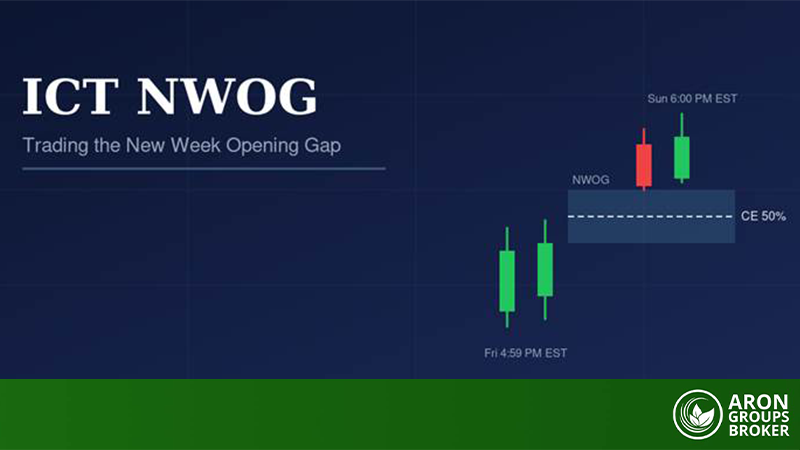



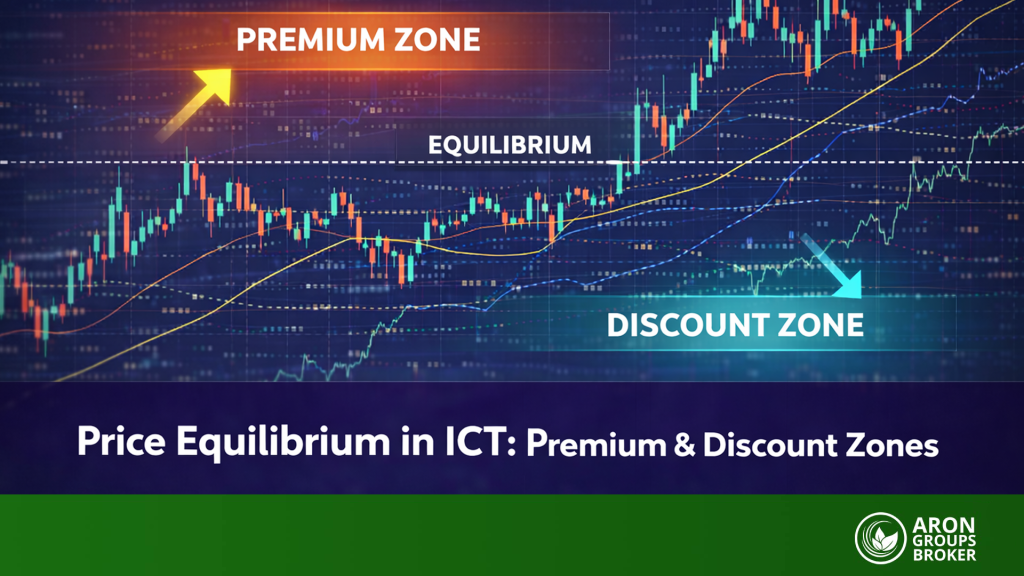

ICT Equilibrium is the 50% midpoint of a clearly defined dealing range. It acts like a fair price reference that splits the range into premium (above) and discount (below). That sounds simple, but most traders misuse it. They either trade right on the midpoint or they keep shifting the range until the midpoint fits. So the real question is: are you using equilibrium to filter entries and bias, or are you treating it like a magical support/resistance line?
Understanding the ICT Equilibrium Concept
Equilibrium is not a standalone strategy. It is a reference level that helps you judge value inside a range. Your first job is to define the range correctly. Your second job is to use EQ to avoid low-quality entries.
ICT Equilibrium Definition and the Midpoint of the Dealing Range
According to TradingFinder, in ICT language, equilibrium is the 0.50 midpoint of the dealing range you are analysing. Most commonly, that dealing range is a swing high to swing low used to define premium/discount.
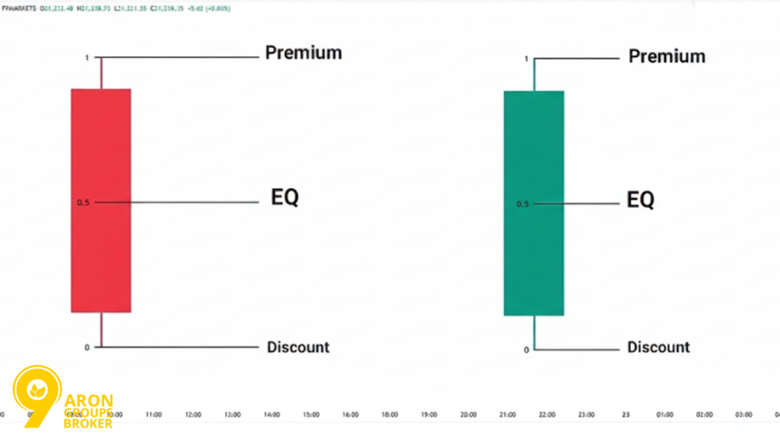
Two practical clarifications matter:
- The 0.50 midpoint is widely used even though it is not a true Fibonacci ratio.
- Some ICT explanations also talk about equilibrium as the midpoint of a candle’s full wick range. The key idea stays the same: the midpoint of the selected range.
If you cannot point to an obvious high and low, you do not have a stable equilibrium.
Equilibrium Line, Balanced Price Level, and Fair Value
Traders often call EQ a balanced price level or fair value level. That doesn’t mean it will hold. It means it is the mean threshold inside your chosen range.
Use EQ like this:
- As a measuring line, not a trigger.
- As a quick check: Am I buying high or buying value?
- As a context tool: if price keeps chopping around EQ, the market may be in balance, not delivery.
Premium & Discount Zones Around the Equilibrium
Once EQ is marked, the range becomes a simple value map:
- Above 0.50 = Premium (overvalued / expensive relative to the range)
- Below 0.50 = Discount (undervalued / cheap relative to the range)
This is why premium/discount is so useful. It reduces chasing. It improves patience. And it makes your entry planning cleaner.
Core Trading Principles Around Equilibrium
The most profitable use of equilibrium is not price touched 0.50, so I trade. It is using EQ to shape bias, location, and expectations—especially when liquidity is resting on both sides of the range.
Directional Bias: Buy Below, Sell Above
A common ICT-style bias filter is simple:
- Prefer buys below the equilibrium (in discount).
- Prefer sells above the equilibrium (in premium).
How to apply it in a practical way:
- If your setup forms right on EQ, downgrade it. Midpoint trades are often messy.
- If price is in premium and you want to buy, ask: Why am I buying expensive?
- If price is in discount and you want to sell, ask: Why am I selling cheap?
Aligning Equilibrium With Higher-Timeframe Ranges
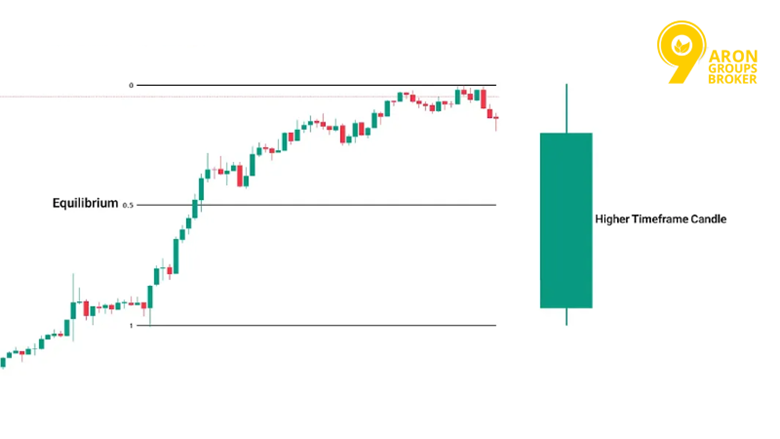
Equilibrium works best when it is aligned to a higher-timeframe dealing range. That range should be obvious. It should not move every time a new candle forms.
A clean alignment routine:
- Pick the HTF swing high/low that matters (Daily/4H/1H depending on your style).
- Mark EQ on that HTF range.
- Drop to lower timeframes only for execution, not to redraw the range.
Failure case to watch:
- If you keep shifting boundaries to save the idea, you are building a false range. Your equilibrium becomes meaningless.
Smart Money Accumulation and Distribution Around the Midpoint
As reported by Fluxcharts, in ICT/Smart Money Concept storytelling, accumulation and distribution often happen within ranges. EQ acts as the centre line that helps you see where price is being treated as cheap or expensive.
A practical way to read it:
- Repeated reactions in discount can suggest demand is defending lower prices.
- Repeated reactions in premium can suggest supply is defending higher prices.
Also, keep liquidity in mind:
- Liquidity often sits above the range high and below the range low. EQ helps you avoid entering in the middle while price is still being drawn to those edges.
Tools and Techniques for Precision Entries
Equilibrium becomes tradable only when you treat it as context, not a trigger. Your tools should do two jobs: (1) mark the true midpoint of a clearly defined range, and (2) help you avoid entries in the no-edge area around the midpoint.
Using the 50 Percent Retracement Method
ICT Equilibrium is the 0.50 midpoint of the range you’re measuring. Most traders mark it with a Fibonacci retracement tool, even though 0.50 is a midpoint convention rather than a Fibonacci ratio.
How to mark EQ (clean and repeatable):
- Choose a clear dealing range, high and low (one swing you can defend).
- Draw Fib from high → low (or low → high).
- Keep only the 0.50 line visible (label it EQ).
- Freeze the range. Don’t redraw it mid-trade.
Entry Filtering and Risk Management at Equilibrium
Equilibrium is where trades often get messy. Price is balanced there. It chops. That’s why EQ works best as a filter for risk management: it stops you from buying high and selling low inside the same swing.
Practical rules that improve consistency:
- Avoid entering on EQ. Wait for a premium or a discount.
- If your plan is long, prefer entries below EQ (discount). If short, prefer entries above EQ (premium).
- Keep invalidation structural. Don’t put stops on a random candle.
- If price keeps flipping across EQ, reduce the size or stand down. That is balance.
Interaction With Liquidity Targets on Both Sides
Liquidity tends to cluster at obvious highs and lows. So in many ICT narratives, price is pulled toward targets on both sides of the range. EQ sits between those targets. It helps you avoid entering while price is still deciding which side to deliver.
A simple way to use EQ with targets:
- Mark liquidity above the range high and below the range low.
- Ask: Which side is untouched and more obvious?
- Use EQ as the do-not-chase line. If price is above EQ, be cautious with longs. If below EQ, be cautious with shorts.
This is not a prediction. It is risk control.
Using FVG and Order Blocks for Enhanced Precision
Equilibrium gives you a location. FVGs and order blocks can give you the entry handle. In Smart Money style education, these are common tools for timing entries after a move shows intent.
How to combine them without overcomplicating:
- First, decide if you want to buy a discount or sell a premium.
- Then look for a clean PD feature in that half:
- Fair Value Gap (FVG): a three-candle imbalance zone price may revisit.
- Order block: a key candle/zone linked to a strong move and later reaction area (SMC framing).
- Use the FVG/OB as the entry zone. Keep invalidation just beyond the zone that proves you wrong.
Practical Applications and Strategy Examples
The fastest way to internalise equilibrium is to watch how price behaves around it across different market conditions. Most mistakes come from treating EQ like support/resistance rather than a value split.
Trading Around the Equilibrium Price in Real Market Conditions
Range day behaviour: price often rotates around EQ. Trades taken near the midpoint tend to chop. Better trades usually come from extremes.
Practical approach on a range day:
- Let price reach a premium or a discount first.
- Wait for a reaction (rejection/acceptance).
- Use EQ as a take-profit magnet for partials, not as an entry trigger.
Integrating Premium and Discount Zones Into Your Strategy
Make premium/discount a daily routine, not an occasional trick.
A clean pre-trade routine:
- Define the higher-timeframe swing range.
- Mark EQ.
- Label the top half as premium, the bottom half as discount.
- Decide: Today I only look for buys in discount or only sells in premium.
This single constraint reduces impulsive entries. It also makes your journaling clearer.
Lessons From High-Probability ICT Setups and Case Studies
High-probability ICT-style setups tend to share one theme: price shows intent away from a zone, then offers a retracement to a clean level.
Three common lessons you’ll see repeatedly:
- Don’t trade the midpoint. Wait for the premium/discount location.
- Let price confirm. Use a displacement move, then a return to an FVG/OB for execution.
- Targets matter. Price often interacts with liquidity on both sides. Plan for where it would reasonably run next.
Managing Failure Cases: False Ranges and Shifting Boundaries
Most equilibrium failures are not EQ failures. Their range selection is failing.
Common failure cases:
- You chose a false swing. The range is not meaningful.
- You keep shifting the high/low to match price.
- EQ breaks with no reaction because the market is expanding, and your range is outdated.
Practical fixes:
- Anchor EQ to a clear higher-timeframe range.
- If new structure forms (new significant high/low), redraw once. Then stop.
- If EQ is repeatedly ignored, treat it as invalid for that range and reassess your swing selection.
Conclusion
ICT Equilibrium is the 0.50 midpoint of a clearly defined dealing range. It splits price into premium vs discount and helps you filter entries: avoid trading in balance and focus on better-priced locations. Align it with higher timeframes, map liquidity on both sides, and use FVGs or order blocks for precision entries in the correct half of the range.
If you keep one rule: don’t force trades at EQ. Let equilibrium guide where you shouldn’t trade, so your best trades become easier to see.