







On the first Friday of every month, the foreign exchange market holds its breath. At 08:30 Eastern Time, the U.S. Bureau of Labor Statistics releases the Non-Farm Payrolls report, and within seconds, major currency pairs can move 50 to 100 pips or more. For traders with a plan, this volatility creates opportunity. For those without one, it creates damage.
The NFP report measures the net change in U.S. employment across all sectors except farming, private households, non-profit organisations, and the military. Because the United States is the world’s largest economy and its currency underpins global trade, the employment figure carries outsized influence over Federal Reserve policy expectations, which in turn drive the dollar. A strong beat lifts rate-hike expectations and typically strengthens the USD. A significant miss does the opposite.
This guide breaks down what the NFP report contains, why it moves forex markets with such force, how to prepare before the release, and three structured trading strategies, the pullback method, the fade, and the pre-release range breakout, that traders use to capture opportunity while managing the inherent risk.
What the NFP Report Contains and Why It Moves Markets
The Employment Situation report, commonly referred to by its headline figure, the Non-Farm Payrolls number, is a composite release. Understanding the individual components helps traders interpret the data more accurately than reacting to the headline alone.
Headline Non-Farm Payrolls
This is the figure that generates the initial market reaction. It represents the net number of jobs added or lost in the previous month across non-agricultural sectors. The market compares the actual print against the consensus forecast compiled from analyst estimates. A significant deviation from consensus, typically 50 000 jobs or more in either direction, produces the sharpest moves.
Unemployment Rate
The unemployment rate measures the percentage of the labour force that is actively seeking but unable to find employment. A declining unemployment rate supports the narrative of economic strength, while a rising rate raises concerns about a slowdown. The unemployment rate sometimes contradicts the headline payrolls figure, which can produce a mixed or whipsaw reaction.
Average Hourly Earnings
Average hourly earnings measure wage growth on a month-over-month and year-over-year basis. Because wage inflation feeds directly into consumer price inflation, this sub-component has gained importance in recent years. A market expecting stable payrolls growth may still react sharply if average hourly earnings surprise to the upside, because it raises the probability of a more hawkish Federal Reserve stance.
Revisions to Prior Months
Each NFP release includes revisions to the previous two months. A strong headline number can be offset by significant downward revisions, and vice versa. Traders who react only to the headline risk missing the full picture. Reading the revisions alongside the current month’s data provides a more accurate assessment of the employment trend.
How the NFP Report Affects Currency Pairs
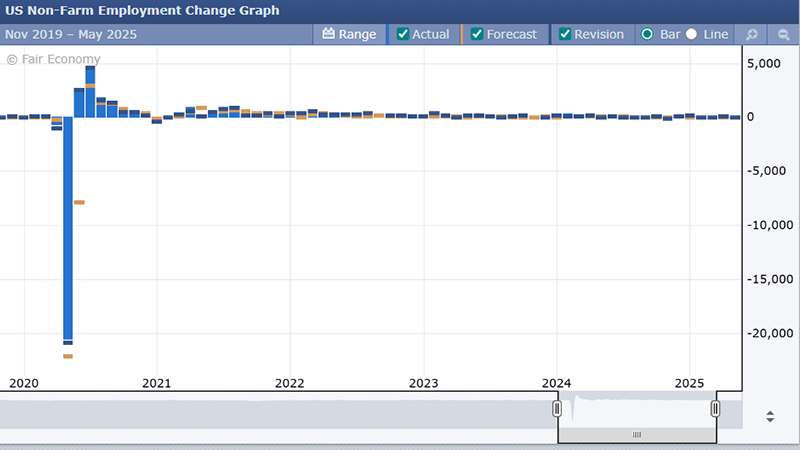
The NFP’s influence on forex operates through the interest rate expectations channel. The Federal Reserve monitors employment data closely when setting monetary policy. Stronger employment supports tighter policy (higher rates or hawkish guidance), which strengthens the dollar. Weaker employment supports looser policy (lower rates or dovish guidance), which weakens the dollar.
Typical Market Reactions
The following table summarises the standard directional response to NFP outcomes across the most commonly traded pairs:
| NFP Outcome | Typical USD Reaction |
|---|---|
| Actual significantly above forecast | USD strengthens. EURUSD and GBPUSD fall. USDJPY rises. |
| Actual significantly below forecast | USD weakens. EURUSD and GBPUSD rise. USDJPY falls. |
| Actual near forecast (within 20K) | Muted initial reaction. Sub-components (wages, revisions) determine direction. |
| Strong headline but weak wages | Mixed. Initial USD strength may fade as wage data tempers rate expectations. |
| Weak headline but strong wages | Mixed. Initial USD weakness may reverse as inflation concerns dominate. |
Gold (XAUUSD) typically moves inversely to the dollar. A strong NFP that lifts the USD tends to push gold lower, while a weak NFP that weakens the USD tends to lift gold. Equity indices react with more nuance: strong employment is positive for growth expectations but negative if it raises rate-hike fears.
Preparing Before the NFP Release
The traders who profit from NFP are those who prepare before 08:30 ET, not those who scramble after the number drops. Preparation involves three steps.
Check the Consensus Forecast
The consensus forecast is available on any reputable economic calendar. Compare the forecast with the previous month’s actual figure and with the recent trend (three-month average). A forecast that is significantly above or below the recent trend tells you that the market is already positioned for a shift, which affects how aggressively price may react to an inline print versus a surprise.
Review Leading Indicators
Several data releases published before NFP Friday provide clues about the likely outcome. ADP private payrolls (released on the Wednesday before NFP), initial jobless claims (weekly), and the ISM manufacturing and services employment sub-indices all contribute to pre-release positioning. Whilst none of these perfectly predict NFP, they help the trader gauge whether the consensus forecast is likely to be confirmed or challenged.
Mark Key Technical Levels
Before the release, mark horizontal support and resistance on the 15-minute and H1 charts of EURUSD and GBPUSD. Identify the pre-release consolidation range (the high and low of the 30 to 60 minutes before 08:30 ET). These levels become reference points for breakout entries, stop-loss placement, and profit targets after the number is released.
Three NFP Trading Strategies
No single strategy works for every NFP release. Market conditions, the size of the surprise, and the clarity of the sub-components all influence which approach is most appropriate. The following three methods cover the most common scenarios.
Strategy 1: The Pullback Entry
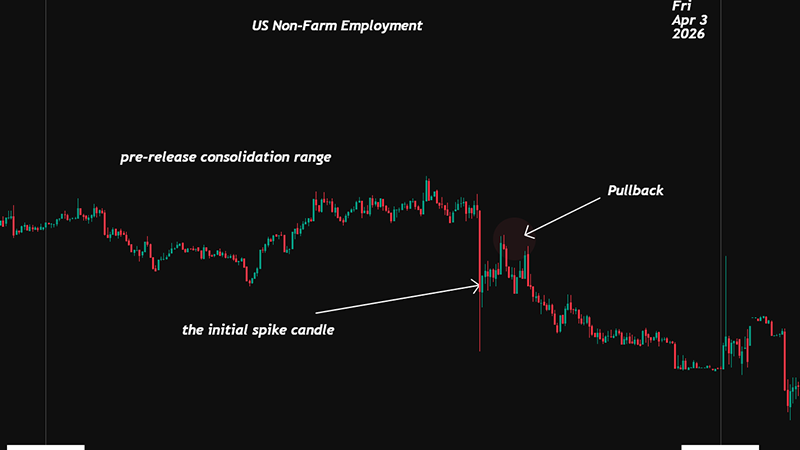
This is the most conservative and widely used NFP strategy. After the initial spike (which typically lasts 5 to 15 minutes), price often retraces before continuing in the direction of the dominant reaction. The trader waits for the first pullback, enters in the direction of the initial move, and targets the next technical level.
Setup: Wait at least 15 minutes after the release. Let the spread normalise. Identify the direction of the initial move.
Entry: Enter on the first pullback that holds above the pre-release range (for a bullish move) or below it (for a bearish move). A bullish engulfing candle or a pin bar on the 5-minute chart provides the entry trigger.
Stop-loss: Below the pullback low (for longs) or above the pullback high (for shorts). Allow wider stops than normal: 25 to 40 pips is common on NFP days.
Target: The next significant H1 support or resistance level, or a fixed risk-to-reward ratio of 1:2.
Strategy 2: The Fade
The fade strategy is based on the well-documented tendency for the initial NFP spike to reverse, partially or fully, within the first 30 to 60 minutes. This V-shaped reaction occurs most frequently when the headline surprises in one direction but a sub-component (wages, revisions) contradicts it, or when the market was already heavily positioned for the outcome.
Setup: Watch for the initial spike to stall and form a reversal candle (e.g. a shooting star after a bullish spike, or a hammer after a bearish spike) on the 5-minute chart.
Entry: Enter in the opposite direction of the spike once the reversal candle closes. This is a counter-trend entry and carries higher risk.
Stop-loss: Beyond the extreme of the initial spike. This stop can be wide, so position size must be reduced accordingly.
Target: The pre-release consolidation midpoint is the first target. The opposite side of the pre-release range is the extended target.
Strategy 3: Pre-Release Range Breakout
In the 30 to 60 minutes before the NFP release, price typically compresses into a narrow range as traders reduce exposure. The breakout strategy places pending orders above and below this range, allowing the market to determine direction.
Setup: Draw a box around the high and low of the 30 minutes before 08:30 ET (08:00 to 08:30). Measure the range width.
Entry: Place a buy stop 5 pips above the range high and a sell stop 5 pips below the range low. When one order is triggered, cancel the other (OCO logic).
Stop-loss: The opposite side of the range plus a buffer (5 to 10 pips).
Target: A multiple of the range width. A 15-pip range with a target of 2x the width yields a 30-pip profit objective.
Q: Should I trade every NFP release?
A: No. Some months produce cleaner setups than others. When the actual figure is very close to the consensus and the sub-components are mixed, the resulting whipsaw is difficult to trade profitably. Experienced NFP traders treat selectivity as a risk management tool: they prepare every month but only execute when the data deviation is clear and the price action confirms a tradeable pattern.
Risk Management on NFP Days
NFP volatility amplifies both opportunity and risk. Three specific adjustments protect capital during these high-impact events.
Reduce Position Size
Wider stops are necessary on NFP days because price can swing 30 to 50 pips within minutes. To keep the dollar risk per trade constant, reduce the lot size proportionally. A trader who normally risks 1% of the account with a 15-pip stop should halve the position size if the NFP stop is 30 pips.
Account for Spread Widening
In the seconds before and after the release, bid-ask spreads on EURUSD can widen from 0.5 pips to 5 pips or more, depending on the broker. This spread expansion can trigger pending orders prematurely or fill market orders at prices far from the screen quote. Waiting 2 to 5 minutes for spreads to normalise before placing any trade is the simplest protection against this risk.
Avoid Holding Through the Release
Holding an existing position through the announcement is effectively gambling on the outcome. Even a position with a wide stop can be stopped out by a spike that briefly exceeds 100 pips before reversing. Closing or hedging positions before 08:30 ET and re-entering after the initial volatility subsides eliminates this exposure entirely.
Read More: How to Make Better Decisions Through Volume Analysis
Common Mistakes When Trading NFP
Three errors consistently undermine NFP trading results.
Chasing the Initial Spike
Entering 40 pips into a 60-pip move typically means buying the top or selling the bottom. The initial spike is driven by algorithmic execution and is often followed by a retracement. Traders who wait for the pullback avoid this trap.
Ignoring Revisions and Sub-Components
A headline of 250 000 new jobs looks bullish for the dollar, but if the previous two months are revised down by a combined 100 000 jobs, the net picture is less impressive. Similarly, weak average hourly earnings within an otherwise strong report can temper the bullish reaction. Reading the full report, not just the headline, is essential.
Overleveraging
The excitement of a 100-pip move tempts traders to increase position sizes. On an event that can produce a 50-pip whipsaw in either direction within 60 seconds, excessive leverage is the fastest route to a margin call. Treat NFP as a high-volatility environment that demands lower leverage, not higher.
Q: Which currency pairs are best for NFP trading? A: EURUSD is the most popular choice because it has the tightest spreads and the highest liquidity during the New York session. GBPUSD is the second most common. USDJPY responds well when the data clearly shifts rate expectations. XAUUSD (gold) offers a high-beta alternative for traders comfortable with wider spreads and larger absolute pip movements. Avoid exotic pairs during NFP; their spreads widen disproportionately and liquidity thins. |
Read More: Forex Market Hours
Conclusion
The Non-Farm Payrolls report is the single most impactful scheduled event in the forex calendar. It concentrates institutional attention, retail participation, and algorithmic execution into a window of minutes, producing volatility that dwarfs any other regular release. That concentration of energy creates genuine opportunity for traders who approach the event with a plan, a tested strategy, and disciplined risk controls.
Prepare by reviewing the consensus, the leading indicators, and the key technical levels. Choose one of the three strategies, pullback, fade, or range breakout, based on the clarity of the data and the price action after the release. Reduce position size, wait for spreads to normalise, and never chase the initial spike. Applied consistently across months, this framework converts NFP from a feared event into a structured component of the trading calendar.